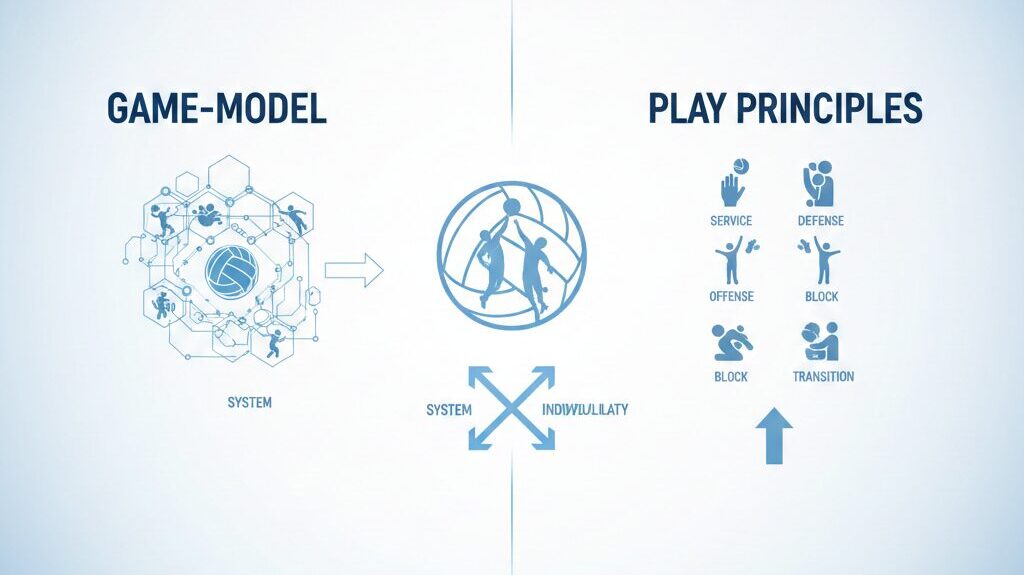
The Volleyball Nations League (VNL) is proving to be an absolute masterclass in modern tactics.
While every team brings its own unique flavor and star players, the Polish Men’s National Team stands out for its exceptionally clear Game-Model and Play Principles.
In the world of football, it has become standard practice for teams to define a Game-Model. In Japan, you can easily find books and magazines detailing how top-tier football clubs verbalize and visualize their systems. I believe the time has come for the volleyball community to engage in similar deep-level discussions.
To spark this conversation, I have taken the liberty of drafting a “hypothetical” Game-Model and set of Play Principles for the Polish National Team based on my subjective observations as a volleyball theorist.
What is a Game-Model?
While you can likely imagine what the term “Game-Model” implies, let’s delve a bit deeper. As mentioned, the sport where this term is most commonly used is football. Its history traces back approximately 40 years to Portugal, where it was pioneered by Professor Vítor Frade of the University of Porto.
A Game-Model can be translated as a “Match Blueprint” or “Match Design.” My impression is that the specific definition of these words varies slightly from person to person. Therefore, I’d like to provide a simple explanation incorporating my own perspective.
If I were to describe a Game Model in different words, I would call it a “Play-System.” In volleyball, it is the comprehensive mechanism that allows the six players on the court to play as effectively and efficiently as possible to achieve victory.
However, that might be too abstract. Rather than me lecturing on it at length, I remembered a much better method. I recalled a YouTube video of the volleyball legend Julio Velasco discussing Game-Models using a perfectly clear analogy. I believe there is no better explanation than this. Please read this excerpt from his interview: