In modern volleyball, the importance of the block play continues to escalate. In this article, I want to explore the essence of blocking, starting with insights gained from a close reading of the official rules.
Why the Distinction Between ‘Hit’ and ‘Contact’?
To truly understand volleyball, one must “begin with the rules.” With this in mind, I reviewed the FIVB Official Volleyball Rules.
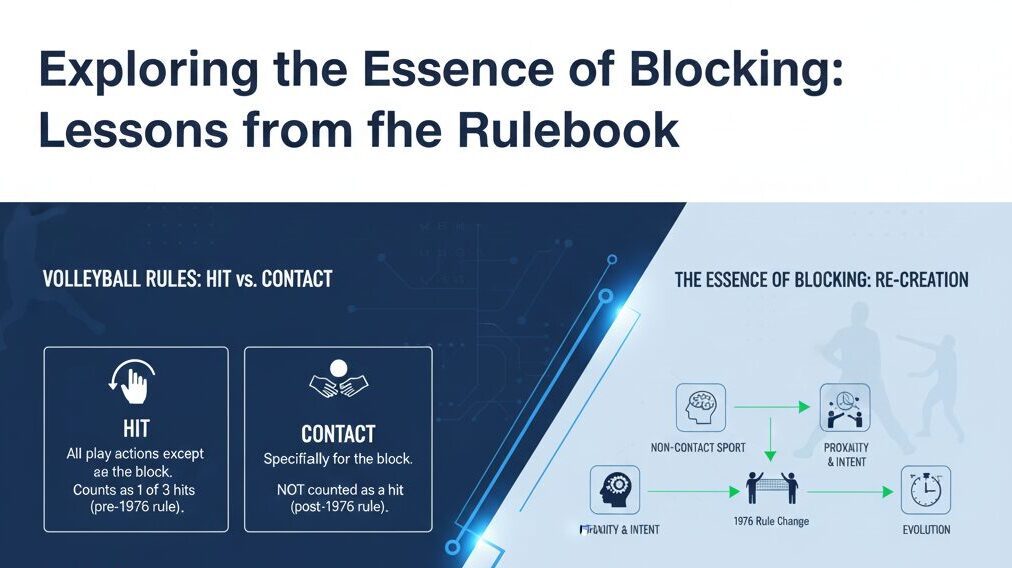
While reading, I noticed a fascinating linguistic distinction. Volleyball, as the name suggests, must be played via a “volley.” However, the rulebook intentionally differentiates between two types of interaction with the ball: “Hit” and “Contact.”
14.4 BLOCK AND TEAM HITS
14.4.1 A block contact is not counted as a team hit. Consequently, after a block contact, a team is entitled to three hits to return the ball.
14.4.2 The first hit after the block may be executed by any player, including the one who has touched the ball during the block.
- hit: Refers to all play actions except the block.
- contact: Specifically reserved for the block.
Do you see the “abnormality” in this?
The rulebook is essentially declaring that “The block is fundamentally different from every other play in the game.” Indeed, blocking stands as a unique outlier in the hierarchy of volleyball plays.
The Evolution of Rules and the Birth of Modern Blocking
When did the block come into existence?
If we look at the history of the sport, blocking did not exist when volleyball was first conceived. In fact, even the technique of “spiking” was not present at the very beginning. It is reasonable to assume that as the spike was established as an offensive weapon, the block emerged as a necessary countermeasure.
But when was the block officially recognized as a “Contact” play, distinct from a “Hit”? The turning point likely occurred nearly 50 years ago with a significant rule change:
1976
The Game – Volleyball Rules major changes in volleyball rules
* Three ball system introduced and three hits after the block introduced to speed up game.
Prior to 1976, the block was counted as one of the three permitted “Hits.” It was not yet recognized as an independent “Contact” action. With this rule change, the block evolved into the unique “Contact” play we know today.
The Meaning of ‘Contact’ in a ‘Non-Contact’ Sport
Even though the block became an independent action, a question remains: Why was the word “Contact” chosen?
Volleyball is strictly a “non-contact” sport. So why use this specific term? While this is my own speculation, I believe it reflects the reality that the block is the closest element to a “contact play” within the sport.
The block is the only play where a player is permitted to penetrate the space above the opponent’s court across the net. It is the action that brings a player into the closest possible proximity to the opponent’s attack—an interaction so close it almost appears as physical contact between the players’ intentions.
Blocking as a Natural ‘Re-creation’
If I were to describe the essence of blocking in one word, it would be “Re-creation.”
The block was not part of William G. Morgan’s original design for the sport. It was “re-created” by the players themselves as they pushed the boundaries of the game. While sports in general are a form of recreation, the block is a perfect example of a “re-creation” that occurred internally within the evolution of volleyball itself.
The history of the block as a distinct “Contact” play is relatively short.
It is a frontier of the sport. While skills and tactics related to blocking (such as Read Blocking or System Defenses) are increasingly being verbalized and codified, it remains a developing area of coaching theory. The presence and impact of the block on the game will only continue to grow.
Keywords/Tags: #VolleyballRules #BlockingTheory #FIVB #CoachingAnalysis #EvolutionOfVolleyball #ContactVsHit #SystemDefense #TacticalDevelopment #YouthVolleyball #SportsHistory #MiddleBlocker