I recently encountered a thought-provoking article in Japanese that I feel compelled to share with you all.
What inspired me most in this article were the words of Mr. Indoh, former head coach of Toyota Auto Body Queenseis. He stated:
“China reached World No. 1 using Chinese terminology. Brazil stood at the top of the world using Portuguese. While I learned from Coach Selinger that everything in volleyball has a name, English terminology isn’t everything. Books like the ‘Volleyballpedia’ rely heavily on Selinger’s ‘Power Volleyball,’ so naturally, his English terms take center stage. However, I believe China has its own terms, and Europe has theirs.”
The Vital Importance of Defining Volleyball Terms
When I read that “China reached World No. 1 using Chinese terminology. Brazil stood at the top of the world using Portuguese.“, I felt a literal shiver of excitement. It made me acutely aware of how the way we define and utilize volleyball terms in our respective regions directly impacts wins and losses. It prompted me to reflect on how we define and operate these terms in Japan—a process that led to several deep realizations.
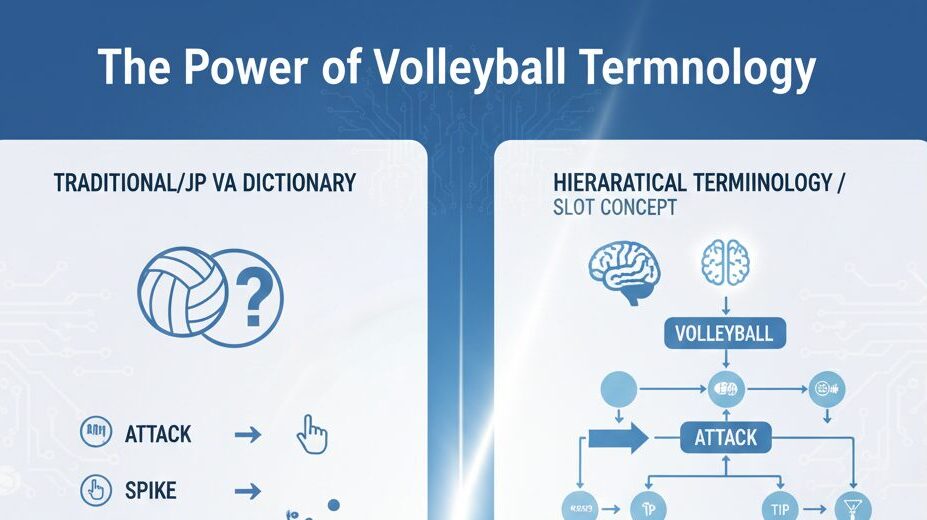
The Simultaneous Use of “Attack” and “Spike”
Looking at the “Unified Terminology” released by the Japan Volleyball Association in July 2018, several points are concerning. A prime example is the treatment of “Attack” and “Spike.” The guidelines suggest using both terms interchangeably to classify skills.
But should we really treat “Attack” and “Spike” as synonyms?
- Attack:
A general term for any offensive play—essentially every action that returns the ball to the opponent’s court. Even returning a ball with an underhand pass is technically an “Attack.” - Spike:
A specific technique used to perform an attack play. It involves an approach, a jump, and hitting the ball powerfully into the opponent’s court.
It might seem like pedantry, but it is a significant distinction. It is more accurate to say that one performs an Attack by utilizing the technique of a Spike.
Understanding Terms as a “Hierarchy,” Not a “List”
Why does the confusion between “Attack” and “Spike” occur? Likely because we have failed to hierarchize volleyball terminology.
Merely listing terms without clarifying their relationships or levels of abstraction is insufficient for deep understanding. If we can organize these relationships and establish a proper hierarchy, we can grasp the sport of volleyball at a much deeper level. This would allow players, coaches, and fans alike to enjoy the essence of the game.
It isn’t enough to simply know many terms. What matters is understanding what those terms mean at their core and having them organized hierarchically within your mind.
Terminology Diversity as a Reflection of Linguistic Diversity
Volleyball is a global sport. Naturally, the languages used vary by country and region, meaning each has its own uniquely defined set of terms.
This idea is thrilling!
Even with limited imagination, one can see that the definition of a single phenomenon or skill can vary wildly across borders. This diversity undoubtedly influences each country’s attitude toward the sport, their training methodologies, and ultimately their Game-Models.
The Potential of Re-evaluating Our Terms
As international interest in volleyball grows, so does the attention toward its terminology. Can we take this opportunity to re-examine and reconstruct volleyball terminology for our own context?
If we can establish a vocabulary that truly captures the essence of volleyball and share it widely among all stakeholders—players, coaches, and researchers—it would have a huge impact on the future of the sport. Refined language leads to refined thought, and refined thought leads to a revolution in play.
Keywords/Tags:
#VolleyballTerminology #CoachingTheory #GameModel #SystemVolleyball #SportsLinguistics #YouthDevelopment #AttackvsSpike #TacticalAnalysis #Haikyu #ArieSelinger #CoachingPhilosophy