I am the kind of author who loves volleyball so much that every thought born in my daily life eventually connects back to the sport. Lately, I have been constantly pondering:
What kind of game is volleyball, exactly?
I have been exploring the essence of the game by analyzing volleyball terminology and verbalizing the “Game-Models” of my favorite teams. To be blunt, I am pursuing this research purely out of passion, setting aside immediate practical gain—I am simply following where my heart leads. There is no greater happiness than this.
Through this exploration, I have verbalized many realizations. However, my current focus is directed toward the structure of the volleyball game.
As I have discussed the sport with more people, my knowledge has certainly increased, and I can now view the game from many perspectives. Yet, I cannot shake the feeling that my current knowledge is just a jumble of pieces forced into a giant toy box. It is not organized. Therefore, I have a powerful desire to capture volleyball more systematically—as a structure, or a “Big Picture.”
In this article, I aim to deepen our understanding by considering the hierarchical structure of volleyball.
Defining the Dimensions (Dimension ① & ②)
When attempting to grasp the structure of the game, I believe the definition of “Dimensions” (Phases) is vital.
I once tried to apply the phase definitions commonly used in soccer directly to volleyball, but it failed completely. Interpretations varied too much from person to person. From that experience, I learned that volleyball needs phase definitions specifically for volleyball.
Since then, I have searched for a way to define phases that achieves a “common understanding.” Here is my current conclusion. First, as a broad framework, I propose defining the dimensions as follows:
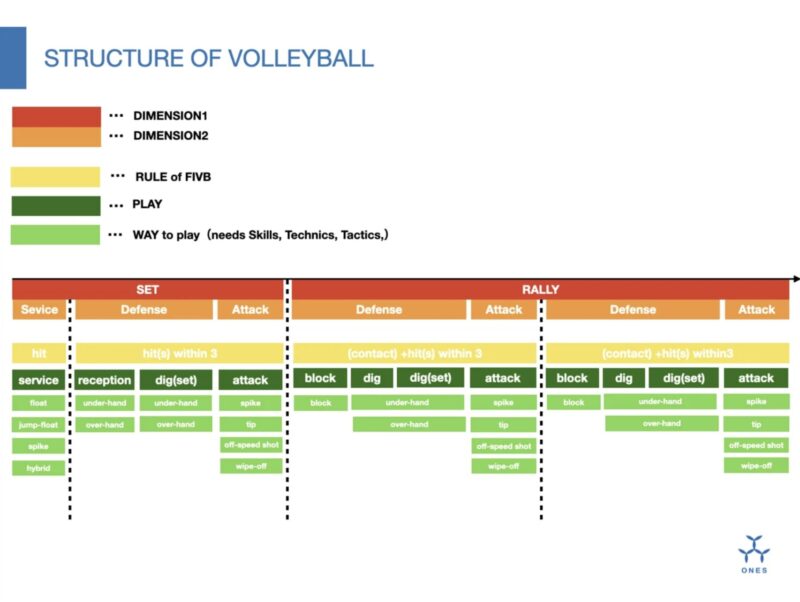
DIMENSION ①
- SET (Set-play Phase)
- RALLY (Rally-play Phase)
At the extreme, a volleyball game can be defined by these two. However, this is too broad to be useful. Therefore, I have subdivided the phases as follows:
DIMENSION ②
- Within SET (Set-play Phase):
1. Service
2. Defense
3. Attack - Within RALLY (Rally-play Phase):
4. Defense
5. Attack
I believe these five definitions will help us understand the hierarchical structure. If the definition is too broad, it isn’t useful for structural thinking; if it is too detailed, it becomes difficult to use in practice. These five are simple, easy to remember, and unlikely to cause significant discrepancies in interpretation.
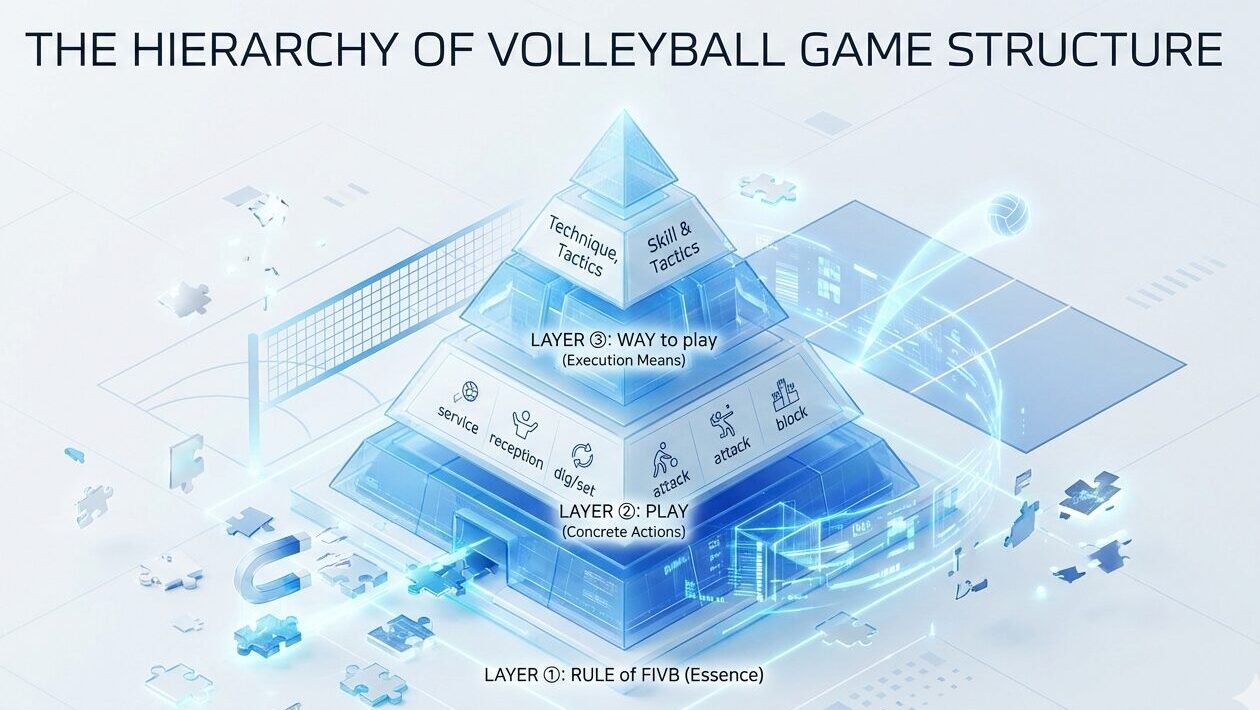
Layer ①: RULE of FIVB
Having defined the dimensions, let’s look at the structure from the bottom up. The most important layer at the base is, naturally, the RULE. In other words, this is the essence of volleyball. Rules literally “govern” the game.
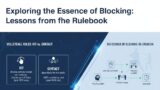
In this layer, I want to highlight two specific terms used in the FIVB rulebook:
- hit: All play actions except the block.
- contact: The block play specifically.
Why does the rulebook use two different words? This is a vital distinction. It implies that the block is in a completely different category from other plays. Understanding this is the key to grasping the essence of blocking.
Layer ②: PLAY
While the rulebook defines play broadly using the two words above, this layer makes those actions more concrete. Play is classified into the following five categories:
- service:
The act of serving. This occurs first in the Set-play phase. Note that it shares a name with the “Service Phase” in Dimension ②. - reception:
Specifically, serve-receive. In Japan, terms like “serve-catch” or “serve-cut” are often used, but these should be understood as slang; it is wiser to avoid them in professional contexts. - dig (set):
All defensive plays excluding reception and block. The word “dig” comes from the image of digging a ball out near the floor, leading some to think it only refers to picking up hard spikes. However, it is a broader concept including picking up free balls. Furthermore, I include “set” here because the second contact that supplies the ball to the attacker is technically part of this flow. - attack:
Every play that sends the ball into the opponent’s court. Crucially, this has nothing to do with “intent.” Whether it is a powerful spike or a simple underhand pass to keep the ball alive, if it goes over the net, it is an attack. - block:
Specifically the act of “interfering” at the net. As noted in the Rule layer, it is the only “contact” play.
Layer ③: WAY to play (Means of Execution)
This layer focuses on the means used to execute the five plays mentioned above. There are examples as below.
- service: float, jump-float, spike, hybrid
- reception: under-hand-pass, over-hand-pass
- dig (set): under-hand-pass, over-hand-pass
- attack: spike, tip, off-speed-shot, wipe-off
- block: block
Note that these are just the representative means.
For example, an attack can be an under-hand-pass, but I have omitted that for clarity. These means evolve with the game. For instance, the “hybrid”—now common in top-tier games—hardly existed ten years ago. This layer is not universal; it shifts as the sport is “re-created” by its players.
The Components of “WAY to play”
What constitutes a “Way to Play”?
As of today, I believe it requires Technique, Skill, and Tactics (Individual/Team). Let’s use the Spike—every player’s favorite—as an example.
1. Technique (techs)
I define this as the physical activity required to complete the movement.
- approach (footwork)
- jump * swing (take-back + forward swing)
- landing
2. Skill & Individual Tactics
Skill: The ability to use the technique to contribute to the team’s scoring.
Individual Tactics: The knowledge of how to play to exercise those skills.These are closely related. I include “Individual Tactics” because, in a net-based sport where you are separated from the opponent, it is dangerous to lose the perspective of “how to fight against the person across the net.”
eg. (skills & individual tactics)
- tempo (adjusting to the set)
- course-hitting / position-hitting
- intentional-blockout
- fake-hitting
- see & response (decision making based on the defender)
- …
*I add “…” to this list because these requirements evolve. As attack and block tactics evolve in pairs, what is required in 10 years may be different from today.
3. Team Tactics
The knowledge required to maximize the scoring ability of all attackers (excluding the Libero).
- time-gap-attacks
- synchro-attacks (simultaneous multi-point attacks)
- …
*this also continues to evolve.
Conclusion: Reflecting on the Hierarchy
By hierarchizing the structure of the volleyball game, I feel I can view it from a much higher vantage point. My knowledge is no longer just “thrown in a box”; it is organized. It feels as though a 3D map of volleyball has been created in my mind. Within this three-dimensional world, I can now identify exactly “where” and “what” I am thinking about or discussing.
I cannot be certain this diagram is perfect—there are likely flaws.
But this is my best current version. Therefore, I sincerely look after feedback from you. Whether via comments, X, or Facebook, please share your thoughts. That is where deep learning begins.
Keywords/Tags:
#VolleyballCoaching #YouthDevelopment #SystemTactics #GameModel #CoachingTheory #VolleyballTerminology #SynchroAttack #SkillAcquisition #IndividualTactics #LongTermAthleteDevelopment #LTAD #FIVB #BlockingSystem #SportsLinguistics