
Most setters in the world stand slightly to the right of the court’s center (slot0).
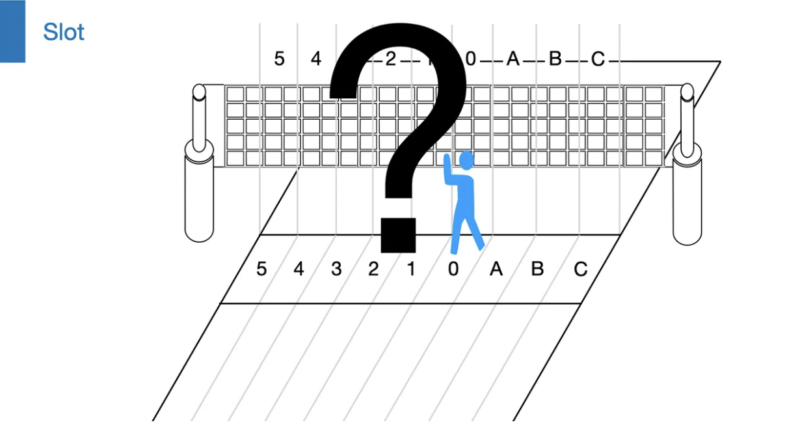
Have you ever wondered why?
As my journey into the depths of volleyball theory progressed, this question began to weigh on my mind. For a long time, I dismissed it as a “minor curiosity.” However, a conversation with a coach I deeply respect suddenly brought clarity to the issue. The more I reflected on it, the more I realized that this is not a minor curiosity at all—it is a fundamental question of tactical evolution.
Before we dive into the “why,” we must first understand the concept of Slots.
The “Slot” System: A Foundation for Offensive Tactics
The Slot System is a linguistic and spatial framework that divides the width of the court into nine sections. Each slot is 1 meter wide, extending from the center line to the attack line.
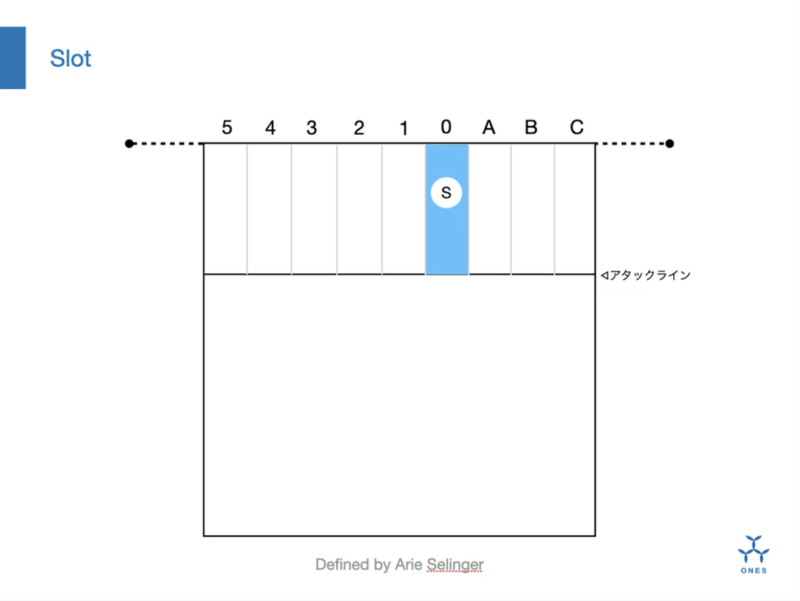
The standard labeling sequence—moving from the left to the right side of the court—is: “5, 4, 3, 2, 1, 0, A, B, C”
In this system, Slot 0 is designated as the setter’s base position, or the “primary target” for the pass. This framework was famously adopted by the 1984 U.S. Women’s Olympic Team.
It was a modification made by Arie Selinger based on the original set-play system proposed by Dr. Jim Coleman.
Why was Slot 0 Chosen as the Standard?
If you were looking at this system for the first time without any volleyball background, you would naturally ask:
“Why must the setter stand in Slot 0 (slightly right of center)?”
However, the longer you have been involved in volleyball, the harder it is to question this. In almost every category and team worldwide, Slot 0 is the “default.” But let’s reset our “volleyball brains” to zero for a moment.
Why did Arie Selinger modify Jim Coleman’s concept?
Why use a mix of numbers and letters?
The answer lies in the evolution of the rules.
The Logic of the 1984 Rulebook
When Selinger refined the Slot System in the early 1980s, the Service Zone was restricted to the right 3 meters behind the end line. Tactics and systems are always born from the constraints of the rules.
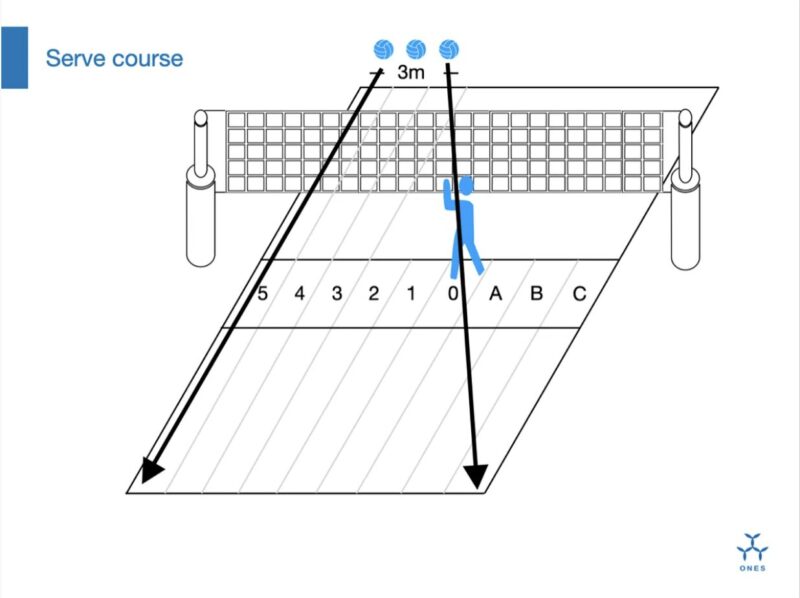
- Rule Context: Until 1994, the server could only serve from the right side of the court.
- Visual Advantage: By standing in Slot 0 and facing toward the left sideline (Position 4), the setter could keep the server, the entire opponent court, and the incoming pass within a comfortable 180° field of vision.
- Tactical Flexibility: From this position, the setter could easily choose between a Forward Set (toward the left) or a Back Set (toward the right) without turning their back to the play, thereby delaying the opponent blockers’ reaction time.
In short, Slot 0 was the mathematical and physiological optimum for a game where the serve always originated from the right side.
When Rules Change, “Optimal” Systems Become Obsolete
In 1994, a major rule change occurred: the service zone was extended to the full 9 meters of the end line.
1994 Rule Change: Service zone extended to nine meters to facilitate serving from any position.
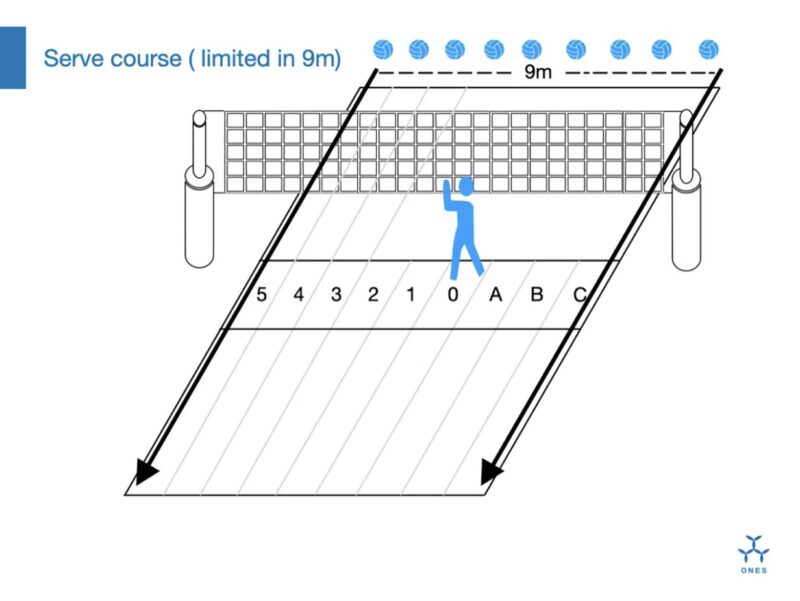
This change fundamentally disrupted the visual logic of Slot 0. If a server stands at the far left and serves toward the setter, a setter standing in Slot 0—still facing the left sideline—now has the server behind their shoulder. The “perfect 180° field of vision” is gone.
Paradoxically, many teams across the globe continue to use the Slot 0 base position as an absolute truth, even though the rule that made it optimal vanished over 30 years ago.
Designing a Modern Set-Play System
How should we update our systems to reflect the current 9-meter service zone?
Here is my proposal for a revised, simplified Slot System:
The “Simple 1-9” Proposal
I suggest a system using only numbers 1 through 9, counted simply from left to right.
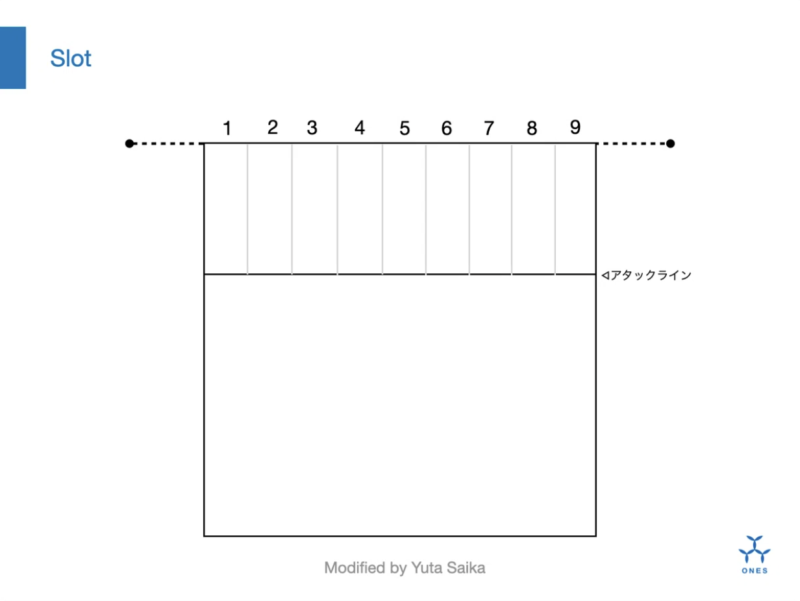
- Intuitive: Most people (particularly in Western and Japanese cultures) read from left to right.
- Clarity: Eliminating the mix of numbers and letters makes the system easier for youth players to grasp instinctively.
- Flexibility: I propose not setting a fixed “Primary Target” or base position.
By not mandating a specific spot for the setter, I encourage coaches to consider their team’s unique strengths. This “zero-base” thinking is what leads to the birth of new, disruptive tactics.
My Personal Preference: The Five-Slot Base
If I were to choose a base position for a modern team under current rules, I would choose Slot 5 (the exact center).
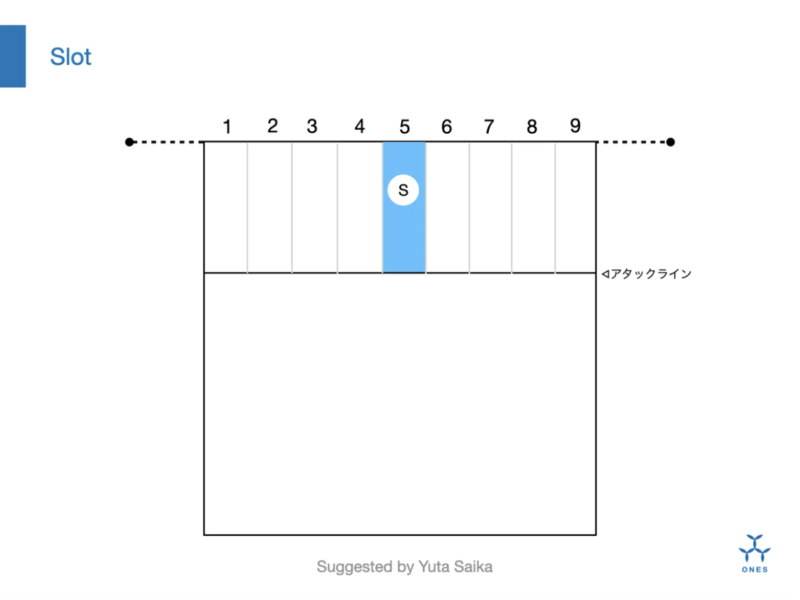
Reasons for the Center (Slot 5) Base:
- Symmetry & Overload: It provides equal space to both the left and right wings. This allows for a more balanced Synchro-Attack (simultaneous multi-point attack), forcing blockers to cover more ground and increasing their decision-making time.
- 360° Awareness: While the human field of vision is 180°, we have necks that rotate 90° in either direction. Standing in the center allows the setter to scan the entire 9-meter width of the opponent’s court with balanced head movement.
Conclusion: Avoid the “Should” Trap
To answer the original question:
Should the setter stand slightly to the right (Slot 0)?
The final conclusion is: We must avoid “dogma” in play systems.
Systems are not universal truths; they are tools that must be consciously updated as the game evolves. The “optimal solution” changes alongside rule modifications and the overall progression of the sport. Volleyball is constantly being re-created—by the way you play it and the way you think about it, right now.
As coaches, we must never stop learning. We must never allow a system to become a “rule” simply because “that’s how it’s always been done.”
Keywords/Tags:
#VolleyballCoaching #SetPlaySystem #ArieSelinger #SlotSystem #TacticalEvolution #YouthVolleyball #SetterTraining #CoachingTheory #GameModel #VolleyballHistory #SportsScience #OffensiveTactics