Few people would react negatively to the phrase, “Nurture talent through praise.” However, teachers and coaches must understand that the manner and purpose of that praise can, paradoxically, inhibit an individual’s growth.
What is ‘Praise’?
Let us first confirm the definition of ‘praise’:
- To celebrate, to bless, to felicitate.
- To evaluate the conduct of (an equal or subordinate) as good and express that feeling; to commend; to admire.
The first definition offers a wonderfully different impression: praise is a form of blessing. What a beautiful notion.
Regarding the second definition, the phrase “(an equal or subordinate)” is critical. Personally, I had always perceived praise as an act limited to a superior commending a subordinate. While that is not entirely incorrect, the inclusion of “equal” in the definition shifts the meaning. Honestly, before reading this definition, I had a certain distaste for the word “praise.” But now, I feel I can embrace it. Praise is a blessing, and it is not limited to an act performed by a superior toward a subordinate.
Praising Ability vs. Praising Effort (Attitude)
The object of praise is extremely important.
Dr. Carol S. Dweck, a psychology professor at Stanford University, conducted a well-known experiment demonstrating this.
Here is a brief summary:
Dr. Dweck tested hundreds of early adolescents with 10 challenging intelligence test questions. Most students achieved moderate scores.
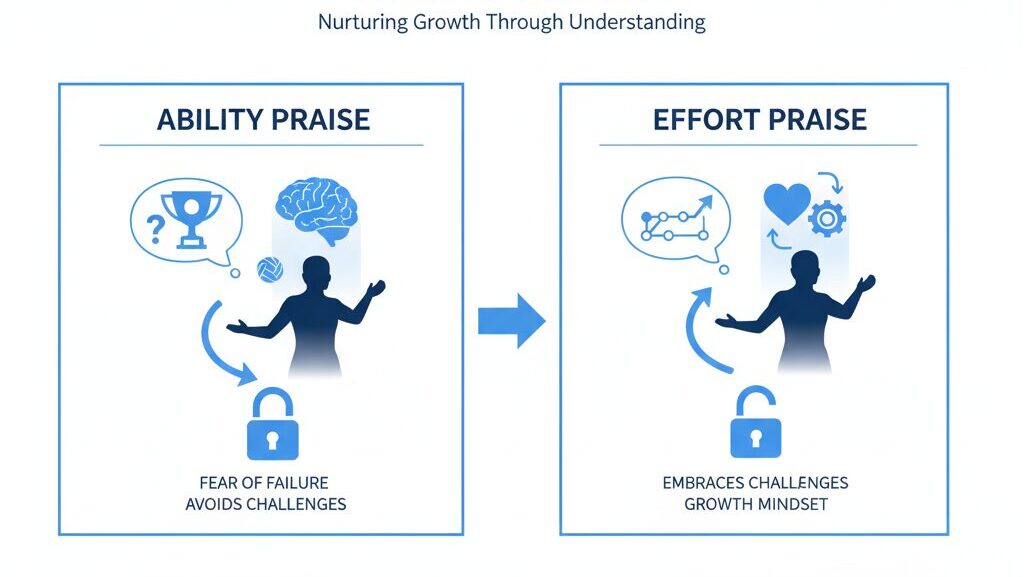
After the test, the students were divided into two groups to receive praise. One group was praised for their ‘Ability’ (“You must be smart”). The other group was praised for their ‘Effort’ (“You must have worked hard”). The academic results of both groups were identical at the time of the division.
Next, students were given a choice: attempt new, challenging problems, or solve the same set of problems again.
A clear difference emerged between the two groups:
- The group praised for ‘Ability’ showed a strong tendency to avoid the new, challenging problems and chose to solve the same problems again.
- Conversely, about 90% of the students praised for ‘Effort’ chose to challenge the new problems.
The insight is profound: when praised for ‘Ability,’ individuals fear being perceived as incompetent and, therefore, avoid challenges necessary for growth. However, when praised for ‘Effort,’ they become more willing to take on growth-oriented challenges without fear of failure.
The act of “praising” may appear the same, but when the object of the “blessing” differs, the resulting behavior is markedly different.
The Attitude and Capacity Required to Observe ‘Effort’
The experiment demonstrates that praising ‘Effort’ fosters individuals who are unafraid of failure and willing to take risks. However, praising effort is not simple; it requires the attitude and capacity to observe effort closely.
Praising carelessly without sufficient observation is likely to be ineffective, or worse, harmful, potentially damaging the relationship. To genuinely praise another person’s effort, you must take an active interest in them:
What is their current capacity?
What is their focus?
What kind of personality do they have?
How are they feeling?
Without keen observation, you cannot truly identify what that individual’s ‘effort’ actually is.
In short, the person doing the praising must possess the necessary attitude and capacity to observe and understand the recipient.
Considering the Purpose of Praise
Finally, let us address the most crucial point: Why do we praise?
Let’s rephrase this into a simpler question: Is the praise for my benefit or for the other person’s?
Is it to make the other person easier for me to control?
Or is it to empower them with the courage to challenge without fear of failure?
I urge every coach to reflect once more on their purpose for praising. If you are praising simply because of a general sentiment—”I should probably praise them just in case”—then taking time to engage in deep introspection is certainly worthwhile.
Writing this article has been a profound opportunity for me to critically reflect on my own coaching practices.
Keywords/Tags:
#Praise #CoachingPsychology #GrowthMindset #AbilityvsEffort #CarolDweck #YouthDevelopment #CoachingTechniques #Motivation #VolleyballCoaching #CoachingPhilosophy