It is an undeniably crucial theme for coaches working within limited time constraints: How to help players learn volleyball more effectively and more efficiently.
In this article, I will analyze the concept of an effective and efficient learning environment, starting with a blog post published on the USA Volleyball website.
I will introduce the main points of the article and supplement them with my own reflections as a coach.
Moving Beyond Reductionism: Embrace Chaos
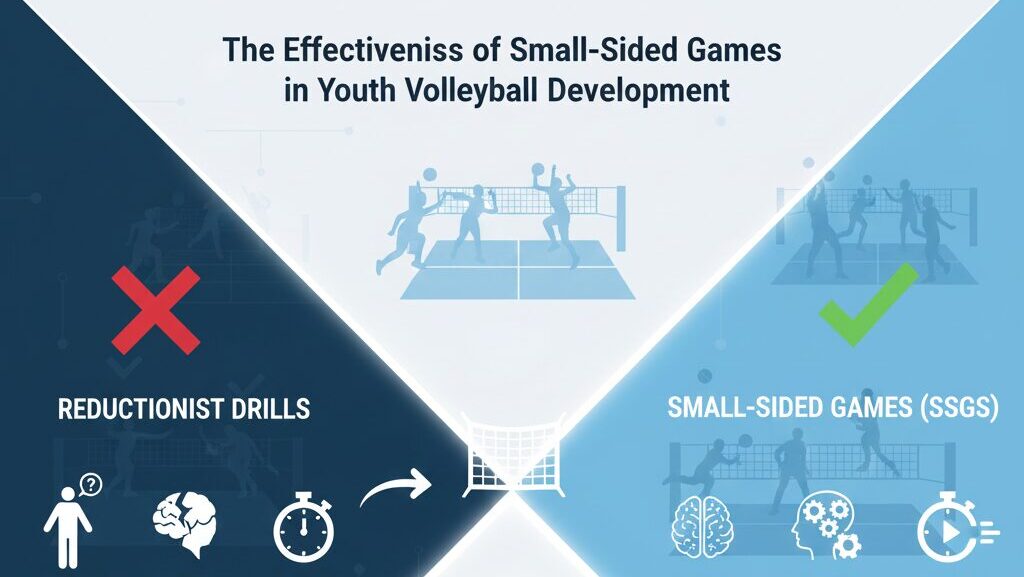
The author of the USA Volleyball blog argues strongly that players cannot learn how to play volleyball through reductionist drill-based learning. More effective learning happens in chaotic practices and games. We must force players into situations that are unexpected for their brains and constantly require problem-solving.
It is true that reductionist drills—the repetitive practices where players know exactly what will happen next—offer minimal learning. They can become easy and boring for the players’ brains, allowing for repetition without thought.
Therefore, the author proposes that game-like practices, which are the opposite of reductionist drills and constantly demand unexpected problem-solving, can enhance learning effectiveness.
The Power of Small-Sided Games (SSGs)
The author proposes using doubles (2v2)—the beach volleyball format—as a concrete method to boost learning efficiency alongside effectiveness.
The reasoning is clear: “The way to develop motor skills is ball contact, not watching someone else contact the ball.”
This is self-evident but compelling. Watching does not improve ball contact skills. By adopting the doubles format, players can significantly increase their ball contacts compared to the 6v6 format.
The author further reflects on the essence of volleyball:
“Volleyball is arguably the most random sport in the world. Not only do 12 players play in a confined space, but unlike golf or tennis, we must contact the ball with our bodies. Every ball contact is unique, and you must read the game correctly to contact the ball at the right place and time to execute a successful play.”
In short, his main point is that ball hitting in volleyball is exceptionally unique and difficult compared to other sports.
Why the Net is Non-Negotiable
The author speaks passionately about the net as a fundamental element that defines volleyball:
“Not using the net is not effective learning. While practicing within the confines of a single court may look good, it removes the stimuli that are guaranteed to occur in a game and denies players the chance to experience game reality. Learning across the net is most effective.”
The message is clear: “No Net, No Volleyball.”
Introducing the net into practice significantly increases the difficulty of any drill. Practices across the net, especially in lower age categories, often look messy. They do not “go well.” Players will inevitably feel stressed.
A coach might even start to doubt their own abilities, thinking the lack of success is due to poor instruction, and may eventually become emotional or angry.
However, the net is always present in a match.
The Long-Term Value of Doubles
Finally, the article concludes by summarizing why doubles are the most effective and efficient method, especially for introducing volleyball to beginners:
“Doubles, or even triples, volleyball is the most effective and efficient way to learn the sport. However, this is only until players are ready to sufficiently learn the tactics, systems, and other options related to 6-on-6 volleyball. Whether indoor or outdoor, I recommend mini-games of 2-on-2 or 3-on-3.”
What is outstanding about this conclusion is that it does not claim that doubles are the only solution. By clearly stating that “things will eventually emerge that can only be learned in the 6-on-6 environment,” the author demonstrates a strong stance on approaching player development from an extremely long-term and planned perspective (LTAD: Long-Term Athlete Development).
Coach’s Reflection
I primarily coach in the junior categories (mostly elementary school age). My time is severely limited—typically two 2-hour sessions per week. I dedicate significant effort to creating an environment where players can genuinely grow within this constraint.
Over the past two years, through extensive trial and error (shikō-sakugo), I have tried countless practice plans. The one thing I have never omitted is game-based practice in the doubles or triples format.
While I do provide verbal feedback and teaching during these small-sided games, and I want to believe that my coaching intervention contributes to player growth, the undeniable fact is that the game environment itself—the 2v2 or 3v3 format—has been the biggest catalyst for player development. The chaos and constant decision-making forced by the small-sided setup are inherently superior learning mechanisms.
Keywords/Tags:
#SmallSidedGames #SSG #VolleyballCoaching #YouthDevelopment #EffectiveLearning #TrainingDesign #TransitionTraining #BallContact #GameBasedLearning #LTAD #CoachingTechniques